THE MEASUREMENT LAYER

Meters & Sensors for Industrial IoT

Every IIoT system is only as good as the data it starts with. Gate-IoT supplies and integrates a wide range of sensors and meters — electrical, environmental, mechanical, and process — and connects them upward through gateways to your monitoring platform.

Request a Quote Talk to an Engineer

Industrial pumps and motors with an energy monitoring dashboard

Why the Sensor Layer Decides Everything

A dashboard cannot be more accurate than the device feeding it. Choosing the wrong range, signal type, or protection rating is the most common reason an IIoT project underperforms.

Right range & accuracy

A sensor oversized for its range wastes resolution; undersized, it saturates. We size it to the actual process.

Right signal type

Analog, pulse, or digital bus — the output has to match what your gateway or PLC can read.

Right for the environment

Ingress protection, temperature range, vibration, and chemical exposure all narrow the shortlist.

Right total cost

Installation, calibration, and replacement cycles matter as much as the unit price.

What We Measure

The measurement areas we most often deliver, each already running in Gate-IoT projects.

Power generation dashboard showing load, solar, grid and battery gauges

Energy & Power Metering

Multifunction power meters, current transformers, and energy meters that track consumption per line, per machine, or per facility.

Voltage · Current · Power factor · kWh · Harmonics

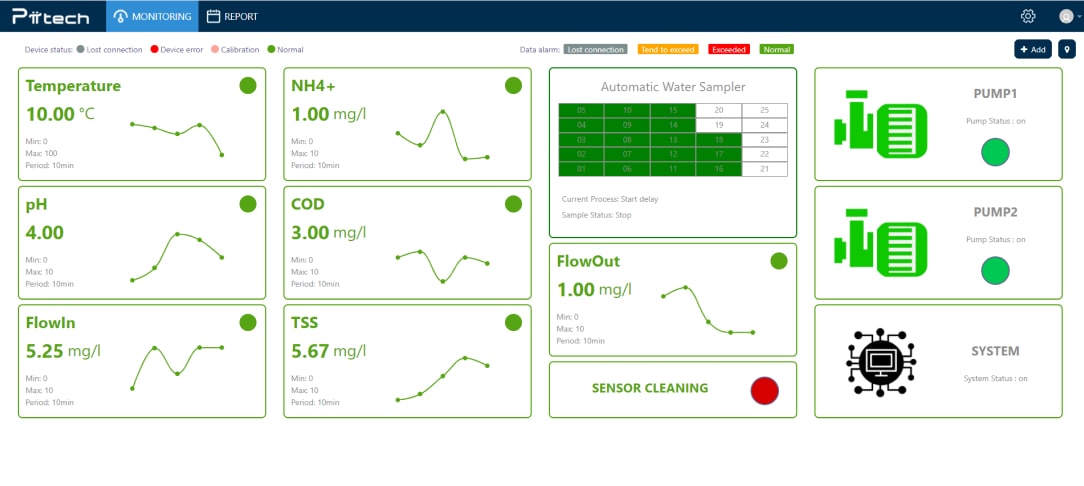
Water quality monitoring screen showing NH4, COD and TSS readings

Environmental & Emissions

Water and air quality instrumentation for compliance monitoring, feeding automated reporting rather than manual sampling.

pH · COD · TSS · NH₄ · Flow · Dust · Gas

Vibration monitoring retrofitted to industrial pumps with readings on a handset

Equipment Condition

Vibration and temperature sensing on motors, pumps, and transformers to catch abnormal behaviour before failure.

Vibration · Bearing temperature · Speed · Runtime

Temperature & Humidity

PT100/PT1000, thermocouples, and combined T/RH transmitters for process and ambient monitoring.

Pressure & Level

Pressure transmitters, differential pressure, and level sensors for tanks, lines, and vessels.

Flow

Electromagnetic, ultrasonic, and mechanical flow meters for water, wastewater, and process fluids.

Gas & Air Quality

CO, CO₂, VOC, dust, and specialised gas detection for safety and environmental compliance.

Water Quality

pH, conductivity, turbidity, dissolved oxygen, and residual chlorine probes.

Position & Proximity

Limit switches, proximity, photoelectric, and encoder feedback for machine state.

Digital & Analog I/O

Remote I/O modules that bring dry contacts and 4–20 mA loops onto the network.

Weighing & Load

Load cells and weighing indicators integrated into production and batching lines.

Signals & Interfaces We Integrate

Whatever the sensor speaks, we bring it onto the network.

4–20 mA0–10 VRS485 / Modbus RTUModbus TCPPulse outputDry contactHARTPT100 / PT1000ThermocoupleIO-LinkLoRaWANNB-IoTWireless / RF

From Sensor to Dashboard

We do not stop at supplying the device. Sensors only earn their cost once the data reaches somewhere useful.

01

Sensor

The measuring device on the machine, pipe, panel, or discharge point.

02

Gateway or PLC

Signals are collected and converted — see our IIoT Devices range.

03

Edge processing

Local logic, buffering, and protocol translation on the Edge Gateway.

04

IoT platform

Dashboards, alarms, trends, and reports on the platform that suits you.

How We Help You Choose

Send us the measurement problem, not a part number — we will work back to the right device.

What are you measuring, and how precisely?

Range, resolution, and accuracy requirements determine most of the shortlist before brand ever enters the conversation.

Where is it installed?

Indoor panel, outdoor pole, submerged, or on a vibrating motor — each implies a different protection rating and mounting.

What has to read it?

An existing PLC, a new gateway, or straight to a platform — this decides the output signal and protocol.

How many points, and how often?

Sampling rate and point count shape the network design and the cost per measurement.

Does it need to satisfy a regulation?

Environmental and energy reporting often dictate certified instruments and calibration records.

What is the budget per point?

We usually propose more than one option across price points, with the trade-offs stated plainly.

Tell Us What You Need to Measure

Describe the process and the constraints. We will come back with sensor options, the gateway to read them, and what the whole point costs.

Contact Us See IIoT Devices